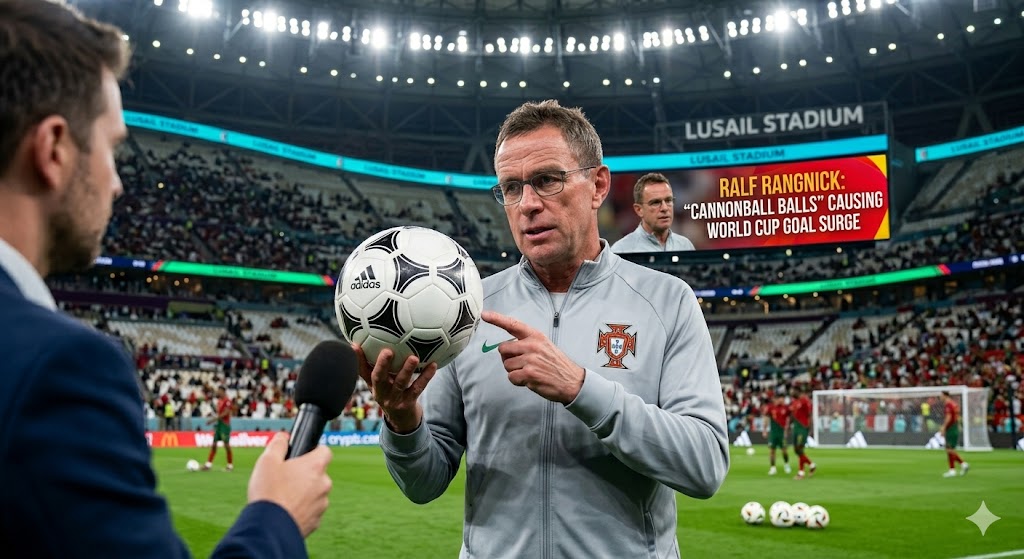
Ralf Rangnick Blames ‘Cannonball’ Match Ball for Surge in World Cup Goals
Published on: Jun 24, 2026
High-Scoring Drama Sweeps the Group Stages
The ongoing FIFA World Cup has transformed into an unprecedented goal fest, shattering modern tournament scoring averages. Across the opening forty matches, teams have combined for an astonishing 121 goals, marking an approximate 25% increase in offensive output compared to the same stretch during the previous tournament. While fans and broadcasters are enjoying the high-scoring thrillers across North American venues, tactical minds are searching for answers behind this sudden defensive vulnerability. Austria national team manager Ralf Rangnick has stepped forward with a blunt, direct explanation for the chaotic scorelines, directing the blame squarely at the tournament's newly engineered equipment.
Tactical Defenses Helpless Against Rocketing Air Travel
As millions of global viewers log on to find active Soccer Streams to keep up with the relentless pace of matches, goalkeepers are finding themselves in completely uncharted territory. Rangnick, whose Austrian side recently suffered a 2-0 defeat against a historic Lionel Messi-led Argentina, noted that the aerodynamic properties of the official match ball are completely overriding defensive structures. FIFA’s engineering department proudly introduced deep-set seams designed for optimal in-flight stability, accompanied by an enhanced surface grip tailored for humid conditions. However, the practical byproduct has been an astronomical increase in terminal velocity, making mid-range efforts nearly impossible to track.
The Professor Outlines the Cannonball Mechanics
"This ball is as fast as a cannonball," Rangnick stated bluntly when assessing the tactical landscape of the tournament. The veteran German tactician explained that the ball's unique construction rewards clean ball-striking with an unpredictable, explosive trajectory. According to Rangnick, if a forward manages to connect with the ball in the sweet spot, the reaction window afforded to goalkeepers shrinks beyond human capability. The sheer speed of the projectile means that textbook positioning and organized low blocks are no longer sufficient to guarantee clean sheets, leading to a massive spike in long-range spectaculars and messy rebounds.
A Perfect Storm of Expanded Factors and Longer Matches
While the aerodynamic "cannonball" remains the primary culprit in the eyes of coaching staffs, it is far from the only variable driving this historic goal surge. The tournament's debutant 48-team expansion has introduced a broader talent disparity in the group stages, creating frequent mismatches that clinical forward lines are exploiting. Furthermore, the implementation of mandatory hydration breaks in high-temperature host cities has led officials to tack on unprecedented amounts of stoppage time. With matches frequently pushing past the 100-minute mark, exhausted backlines are crumbling late in both halves, perfectly setting the stage for attackers to punish them with the hyper-fast match ball.